Le coin du Débutant - Les Agates
|
 |
 |
click on pictures to enlarge.
© Pictures : MJX, except otherwise specified.
Avertissement :
Cette étude est guidée par un livre servant de fil conducteur.
L’auteur s’est engagé à ne pas plagier les textes. Il commente toutefois la structure du livre qui permet au débutant qu’il est - via les moteurs de recherche Internet - de découvrir le monde des agates et surtout ses secrets. Le présent article ne parlera pas de joaillerie ni des techniques associées aux processus industriels, technologiques et commerciaux des métiers liés aux agates.
Comme il a été annoncé dans l'introduction de cette série, le texte proposé reste un fil conducteur pour le lecteur passionné par la minéralogie et la beauté des microcosmes de la nature.
Pour des raisons d’objectivité, nous ne donnons aucun lien avec des sites marchands. Ils sont nombreux sur Internet. Le lecteur trouvera très vite les adresses URL et les visitera. Merci de nous communiquer en retour les sites exceptionnels ou originaux.
G. Declercq
1. Introduction
« Les agates ? Bof …» - « c’est banal » - « c’est d’un commun »
Eh bien NON … le débutant que je suis, depuis toujours, dans le monde des minéraux vous invite à vous arrêter, le temps d’une pause « AGATE ».
Aussi populaire que ce nom semble vouloir dire, qui peut dire exactement ce qu’est l’agate ? Qui peut parler de son origine, sa composition, les lois régissant sa croissance ? Autre question : sommes-nous en présence d’un état de la matière définitif ?
Agate ? Non … LES Agates convient-il de dire.
Histoire d’une découverte. Que dis-je ? … d’un monde inconnu.
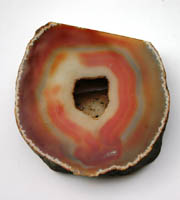
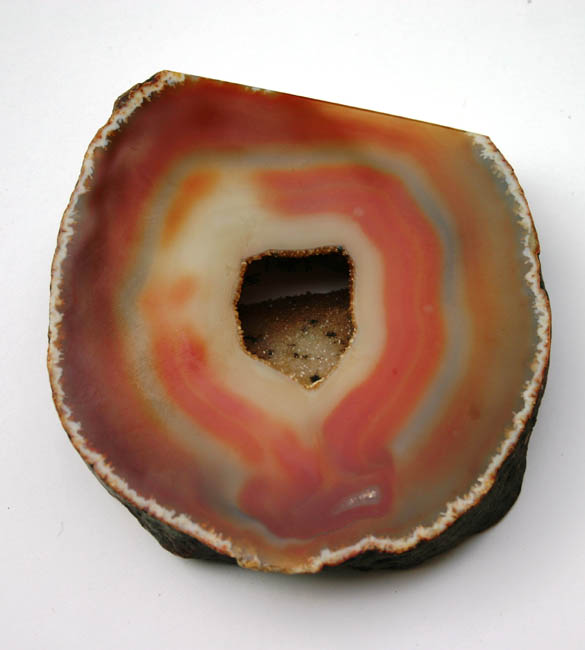
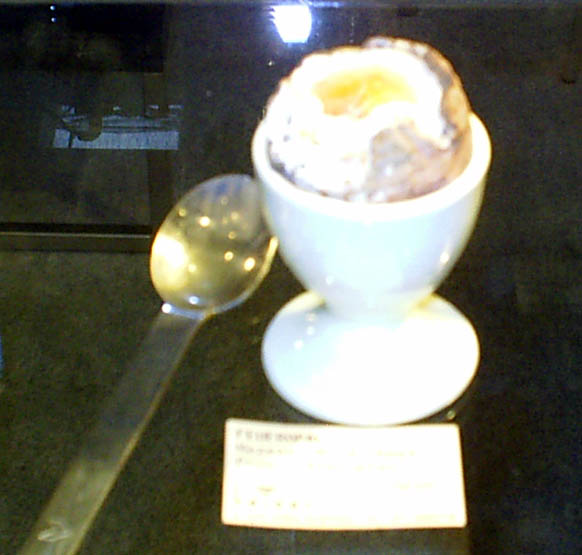
(coll & photo MJX) |
Lors de l'exposition AGAB en novembre 2005, mon attention fut attirée par un nouvel ouvrage sur les agates. "Encore un !", me direz-vous. N'ayant jamais été particulièrement sensibilisé à un minéral que je croyais banal, j'ai pris en main un livre (attention 650 pp ça pèse…).
Coup de foudre pour l'ampleur du travail et de l'impact des couleurs.
Il ne m'a pas fallu longtemps pour me décider à l'acheter.
Rentré chez moi, l'impatience a eu le dessus pour dévorer des yeux les quelque 650 pages de ce je considère une sacrée trouvaille. Ce livre de collection est une extraordinaire compilation sur ce qui est pourtant un joyau de la terre vieux comme le monde. Aussi, je tiens à partager l'émotion de cette lecture aux réels amateurs. Je vous invite à découvrir ensemble ce sentier de la découverte. |
Référence : Un titre tout simple : AGATES de Johann Zenz – Ed. Bode, 2005 , 658 pp , 2000 photos
Appréciation rapide : Je ne tiens pas à faire une publicité imbécile ni stérile, mais ce livre séduit par une compilation extraordinaire de plus de 2000 photos invitant à la lecture des Secrets du Livre de la
Terre : des pierres que l’homme met en valeur par sa compétence dans la sélection du matériau, du sciage et du polissage
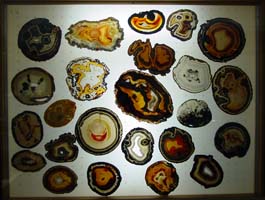
des plaques.
Mots-clefs : Formes inattendues, dessins harmonieux, incompréhensibles ou étranges, formes et couleurs chatoyantes,
captivantes et invitant au dialogue de la pierre qui se dévoile dans son extraordinaire nudité et du lecteur débutant qui s’interroge sans
cesse. Un livre à mettre dans toutes les mains.
2. Pour les gens pressés
Références Les agates en 2 mots :
Collection Guy Oyhanart – 2001 – courte présentation du sujet - bon équilibre pédagogique - 2 pages – Propos tenus :
Etymologie – minéralogie de l’agate – différentes variétés – gisements – « peut-on constituer une collection
aujourd’hui ? »
Il y a aussi : http://en.wikipedia.org/wiki/Agate
3. Les Agates – Histoire
Il est plus que probable que l'histoire des agates remonte à l'âge de la pierre (Sumériens de Mésopotamie, Egyptiens, Babyloniens), cela près de chez nous et très certainement aussi en des temps tout aussi reculés ailleurs dans le monde.
Théophraste (376-287 BC) , médecin, philosophe et naturaliste grec y faisait mention dans son traité « Peri Lithon » ‘Des pierres'. D'après lui, les premiers gisements grecs proviendraient d'un fleuve Akhates (le Dirillo) au Sud de la Sicile.
C'est ainsi que depuis l'Antiquité, les agates entrèrent dans la fabrication d'anneaux, de bijoux, de vases, de produits d'ornementation, etc … grâce à la richesse des variétés de couleurs et l'originalité des formes. On leur attribua aussi une signification de symboles et de valeurs religieuses (sceaux, amulettes, armes, outil). Byzance, Rome ont poursuivi le travail et le commerce des pierres d'agate (cabochons, bagues, …). N'oublions pas la carnelite (Epos de Gligamesh), ni les fameux «Pebbles of Nile». |
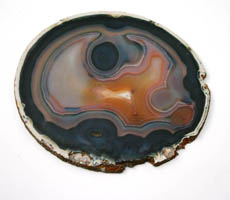
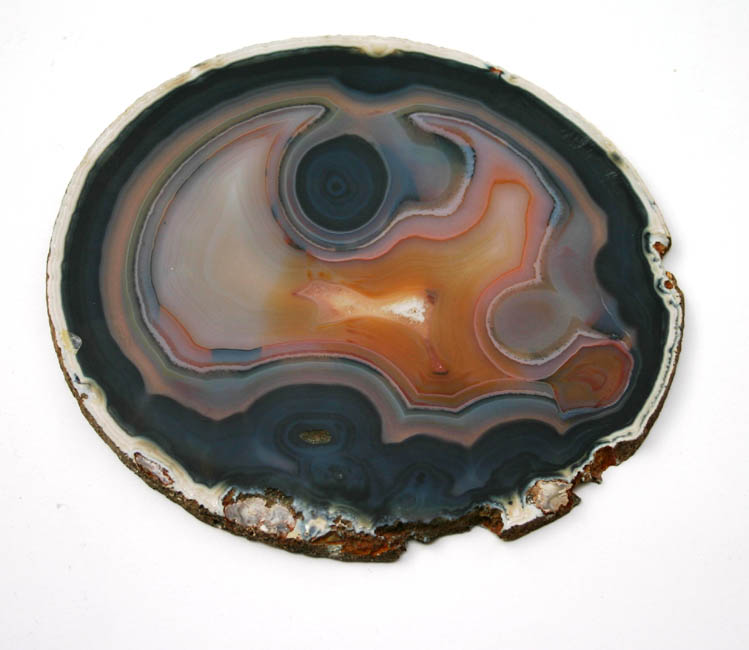
(coll & photo MJX) |
Les agates ont bien une histoire ancienne. Il y a des traces écrites, ainsi :
- Le manuscrit ancien « Codex Vaticanus Graecus 1302 » avec mises à jour des 12 au 14è s. etc …
- En 1755 paraissait à Paris le traité d’ORYCTOLOGIE (« traité des terres, des pierres, des métaux, des minéraux et autres
fossiles »
- M Collini imprimait à Mannheim en 1786 le « Journal d’un voyage qui contient différentes observations minéralogiques
particulièrement sur les AGATES et le basalte – avec un détail sur la manière de travailler les Agates ».
- Aux époques des 18è et 19è s, parurent également de très nombreux ouvrages en allemand. (voir la rubrique ‘historique’ dans l’ouvrage
de Zenz)
L’industrie lapidaire de l’agate a existé de tout temps pour produire des objets de parure ou d’ornementation ou même des pavements.
Certaines découvertes au siècle dernier en Amérique du Sud, à partir d’immenses gisements, ont même conduit à s’en servir de ballast pour
les navires devant rentrer vides en Europe.
Référence :
quelques pages d’un ouvrage simple : Encyclopédie des minéraux – J. Kourimscky – 1979 : pp 149 à 157 chez Gründ
4. Usages industriels
En raison de sa dureté et de sa résistance aux produits chimiques, le matériau d’agate sert aux mortiers de pharmacie et de laboratoire,
de pierre à polir dans les métiers du cuir et du papier, certains appareils de mesure.
5. Les gisements dans le monde
Il est clair qu’un inventaire des gisements dans le monde est tout simplement impossible.
L’auteur du livre à partir duquel nous avons investigué signale même des lieux exotiques tels le Groenland ou l’Antarctique. A fortiori, vouloir constituer une banque d’images très complète devient du fantasme.
Sachons simplement LIRE et pérégriner sur le chemin de la découverte , simplement à la recherche du beau.
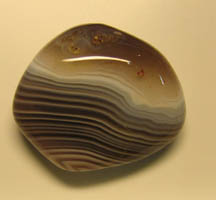
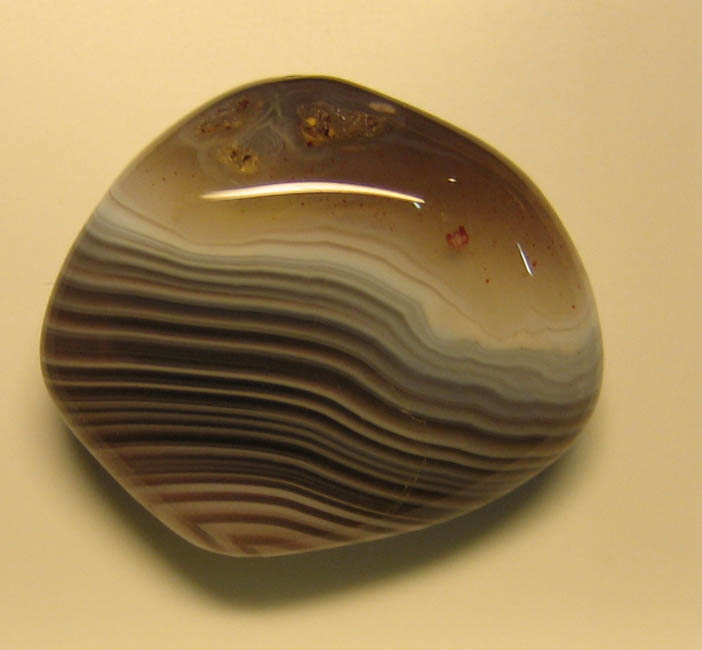
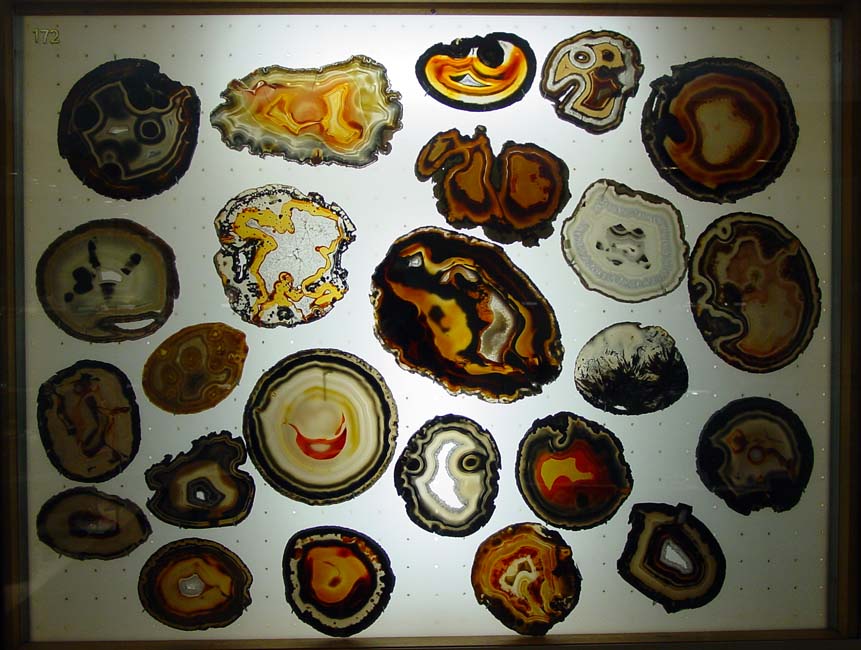
(coll & photo MJX) |
Les gisements européens les plus connus d'Idar-Oberstein (Allemagne), d'Ecosse, de Sicile, de Tchéquie (Monts des Géants), de Saxe (Schlottwitz), de Roumanie, ou d'Afrique du nord telle l'Egypte sont épuisés. Actuellement le Brésil (état du Rio Grande do Sul) exploite de façon intensive des gisements abondants de minéraux de très bonne qualité.
Ailleurs, et quasi sur tous les continents, on trouve des agates en quantités abondantes certes, mais de qualité moindre (Chine, Mexique, Urugay, Indes, Australie, EU, Patagonie, Kazakhstan, Mongolie, Maroc, Oural, Sibérie, Madagascar, France (Esterel) …) - http://www.hunterian.gla.ac.uk (search Agate) |
6. Traductions
Référence : Le débutant en minéralogie, comme tout bon collectionneur averti, sait que l’usage de sa seule langue le coince dans une bulle fort restreinte. L’anglais et l’allemand dans ce domaine sont d’une utilité incontournable. Il reste que les scientifiques de langue hispanique sont tout aussi présents sur le marché que les chinois. Il y a les Italiens et les autres. Que dire des trésors dans les «pays de l’Est », riches d’un patrimoine extraordinaire à découvrir.
Par conséquent : à voir absolument : http://www.answers.com/topic/agate
Appréciation rapide : Assez surprenant comme informations en ligne : ce site vous met à disposition tout ce qu’il faut savoir côté vocabulaire, traductions, prononciations, infos générales : vraiment bien.
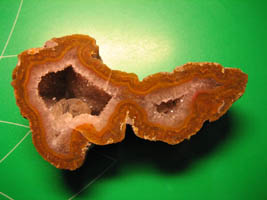
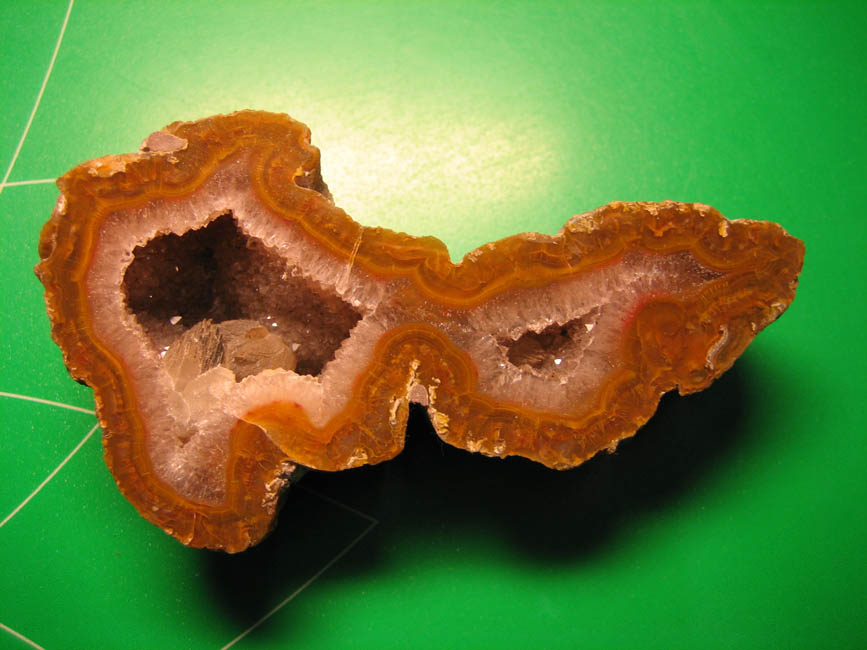
(coll & photo MJX)
7. Les Agates : Minéralogie
Origine :
Les laves basaltiques chargées de gaz remontant à la surface de la terre libèrent des bulles de gaz qui sont à l’origine
de cavités amygdoïdales du mélaphyre et de roches semblables. Sous l’amenée des solutions hydrothermales, des dépôts se forment en
sédimentations rythmiques de la silice à l’état de gel, en couches régulières avec des contenus chimiques et des colorants divers. Dans
les agates creuses, les mécanismes associés à la dissolution des silices et autres minéraux vont permettre la formation des cristaux de
roche, de quartz et d’améthystes.
Propriétés :
De la famille des silices, l’agate appartient au groupe de la calcédoine.
Il s’agit d’un oxyde de silicium SiO2, mélange de calcédoine cryptocristalline, de quartz rhomboédrique et d’opale
amorphe. Par cryptocristallin, il faut entendre « en
assemblage de cristaux très petits (quelques µm), difficilement visibles au microscope optique du fait de la superposition de
plusieurs cristaux dans l'épaisseur de la lame mince (0,02 à 0,03 mm) »
Dureté : de 6.5 à 7 - Densité : 2.49 à 2.64 – fracture conchoïdale
Attention : A l’intérieur d’une seule et même agate(brésilienne), la densité est variable (cfr Pr.HAALE )
Porosité varie de 0.15 à 0.45 % (raison pour laquelle on peut facilement teinter la pierre).
Dissolution aisée dans de l’acide fluorhydrique.
Couleurs :
- En principe, à l’origine de solutions aqueuses, la formation des agates se fait toujours dans des cavités au centre desquelles se
développent des cristaux hyalins ou de type améthyste.
- Mais il y a une multitude inattendue de couleurs :
- Selon le contenu minéral des différentes couches, la structure est de forme filamenteuse à grains très fins, granuleuse ou compacte.
Les colorants minéraux sont le plus souvent l’hématite, la limonite, le manganèse, le chlorite verdâtre. La fine porosité de certaines
agates (brésiliennes) va permettre une coloration artificielle (voir plus bas).
- La couleur bleue est due à l’effet Tyndall, à savoir que la lumière diffuse dans les inclusions submicroscopiques.
- Durant l’observation, la couleur peut donner soudainement l’impression de contenir des stries brunes (cas de lumière de très forte
intensité)
- Autre modification des couleurs : leur disparition ou mutation lors de la présence de certains acides (Bostwana Agates) (cfr Haake 2000)
- Référence : Voir images surprenantes du livre de Zenz p 39.
Système cristallin :
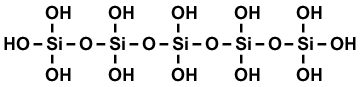
On peut voir que c’est l’oxygène qui assure la liaison avec les atomes de silice.
Minéralogiquement parlant, l’agate est pleine de mystères : encore aujourd’hui, malgré des études récentes très poussées, la genèse des agates reste une source de nombreuses questions.
La première couche observée d’une pierre est généralement un mélange de silice et de moganite. Les couches suivantes sont du quartz pur.
Autre chose curieuse, les fibres d’agate croissent selon un processus hélicoïdal ; elles sont torsadées.
Autre particularité : la direction de cristallisation des fibres : croissance des fibres perpendiculairement à la direction normale du minéral.
Les couleurs proviennent d’éléments tels que le fer ou le manganèse.
Selon la présence plus ou moins forte de manganèse, on obtient des textures « mousse »
La croissance ressemble curieusement à des poupées russes.
ARNOTH en 1986 illustra la manière dont on scie une agate. La forme de la tranche sera tout à fait différente selon l’une ou l’autre perpendiculaire utilisée. Prenez un oignon, coupez-le selon son « diamètre » ou selon le sens de la tige.
Les canaux d’infiltration ou escape channels sont très communs dans les agates. Pour les spécialistes, ils sont synonymes de « Injection holes – access channels – outflow ch., diffusion of solutions ch., evaporation tubes, eruption ch.
RYKART, BLANKENBURG et LANDMESSER expliquent ce phénomène avec une conclusion : « Chaque agate est individuelle, aucune n’est pareille à une autre. Même lorsque des agates sont génétiquement formées ensemble, leurs formes, couleurs, caractéristiques sont différentes ; au point que recoupant une tranche d’agate à quelques mm de la première, des formes différentes peuvent être mises à jour. » Extraordinaire ….
Voir bibliographie Zenz p 41
Les spécialistes s’accordent pour dire que la géochimie de l’agate est une des plus compliquées.
Pour plus de renseignements, consulter le site : http://www.rps.psu.edu/0109/form.html , l’article de Nancy Marie Brown « How do agates form ? » interviewant le prof. Peter Heaney, Ph.D.( associate professor of geosciences in the College of Earth and Mineral Sciences).
Formation des agates
Citons aussi pour info les travaux récents de Rykart (1989), H.R. SCWEIZER (1986), ARNOTH (1986), LANDMESSER (2001), MOXON (1996)
Couleurs
L’agate strictement naturelle est finement zonée concentriquement en rubans de teintes très variées, vivement contrastées et nuancées.
Allant de l’incolore, blanche, grise, brune, rouge, verte noire.
Trucage antique : la plupart des agates commerciales sont artificiellement colorées pour devenir ONYX (teintes blanches
avec bandes noires ou brunes) ou SARDONYX ou sardoine (bandes brun-rouge).
8. Processus de taille et polissage
Nous ne développerons pas ces techniques indutrielles.
Nous renvoyons le lecteur intéressé aux pages 93 à 101 du livre de Zenz, où à la littérature spécialisée.
Une remarque à épingler : la position à genou / couchée sur le ventre (avec un petit coussin) des ouvriers polisseurs des pierres,
face aux grosses meules, généralement actionnée par des moulins à eau.
La réputation mondiale d’Idar Oberstein près de chez nous n’est plus à faire.
9. Agates et fossiles - Démenti
En décembre 2002, l’image d’une spirale à l’intérieur d’une agate a été publiée dans un magazine spécialisé, ce
qui provoqua, on l’imagine, des réactions passionnées et passionnantes sur l’occurrence ou pas de microfossiles au sein des agates.
Dans notre cas: la spirale était de 4 mm de diamètre; provenance de l’échantillon Freisener Höhe (Allemagne).
Des analyses ont prouvé qu’il s’agissait d’éléments inorganiques.
Question : Mais alors, comment expliquer le développement de cette structure ?
Pas si simple mon cher Einstein, vu l’étude de Schäfer en 2002 sur des structures appelées « holosphérulithes de type I et II »).
Pour plus de détail, contactez simplement Gisela Yvonne Lentz, Université de Kiel qui a fait un très bel article + photos (Livre de Zenz pp 88 et 89). Ses coordonnées sont sur le site de l’université : Institut für Mineralogie, Christian-Albrechts Universität, Olshauserstr. 40, 24098 Kiel - Germany :
http://www.ruhr-uni-bochum.de/...
10. Les appellations les plus importantes
A priori pas de règle d’appellation particulière, mais selon leurs formes, les inclusions, les couleurs ou leur provenance, elles porteront le qualificatif de polyédrique, nébuleuse, ruinée, étoilée, mousse, sagénite, plume, bréchiforme, paysagée, oeillée, cornaline,etc. L’agate rayée de noir et de blanc est appelée ONYX.
Parmi des noms évocateurs, nous trouvons l’agate "Condor des Andes", mes "Fleurs de pluie de Nankin", les "Thundereggs" (œufs de tonnerre).
La plus étonnante reste une agate mexicaine qui représente une chouette sur fond bleu nuit : la "Apache hooded Owl".
Cette dernière a servi de thème porteur pour le Mineralogical Show de Munich.
http://www.webmineralshop.com...
(voir aussi sa photo Zenz – p 413)
Parmi les noms en relation avec la signification qu’ils portent quant à leur structure, signalons les Agates...« Eye, Banded, Picture, Dentritic, Thunderegg, Fire, Flame, Fortification,Vein, Iris, Landscape, Liesegang Bands, Fragmented Membrane, Moss, Plume, Tube,...»
Classement Alphabétique des appellations (non exhaustif)
| A |
Abiquiu, Absaroka, Acebuche, Acton Canyon, Achatdruse, Adna, Agua Nueva, Amethyst lace, Angel Wing, Apache- Aparejos, Arizona |
| B |
Banded, Beacon Hill, Bean, Black Hill, Black plume, Blue Ice, Blue Moss,
Blue Pepper, Bostwana, Bouquet, Brecciated, Bull Canyon, Burro Creek |
| C |
Cacholong, Cactus lace, Cady Mountains, Calcedoine, Carey Flame, carey Plume, Carnelian, Carneros, Casas Grandes, Chalcedony, Chrysoprase Cloud, Cobra, Coconut, Condor, Coneto, Copco, Coral, Coyamito, Crazy lace |
| D |
Debris, Dentritic, derramadero, Dot, Dryhead, Dugway, Dulcote |
| E |
Eye |
| F |
Fairburn, Fire, Flame, Flower garden, Fortification |
| G |
Gallego, Grape, Graveyard Point, Gregoria |
| H |
Hi-Fi, Holley-blue, Horse Canyon |
| I |
Iris |
| J |
Janos, Jasper |
| K |
Kentucky, Keswick |
| L |
Lace, Laguna, Lake Superior, Landscape, Lavic, Loma Pinta, Louisiana River, Lucky Strike thunderegg, Luna, Lysite |
| M |
Maury Mountain moss, Medicine Bow, Mes(z)quite, Mocha stone, Moctezuma, Mokka, Montana, Moss, Mozambique |
| N |
Nebraska blue, Nipomo |
| O |
Onyx, Onyx banding, Oregon beach |
| P |
Paint rock, Parcelas, Parrot wing, Picture, Pigeon blood, Pink lace, Piranha, plume, polka dot, Polygonal, Polyhedroid, porcelain, Pom pom, Prairie, Purple passion |
| Q |
Queensland |
| R |
Rainbow, Regency Rose, Rio Grande, Ruin |
| S |
Sagenite, Sard, Sarder, Shadow, Snake chalcedony, Snakeskin, Snowball, Spectacle, Suspended center, Suspended floater |
| T |
Tepee, texas plume, Thunderegg, Tree, Tube, Turitella |
| U |
Union Road, Urugay banding |
| V |
Valley View, Vein |
| W |
Waegeler, Wegeler , Wackler, Wascoite, Water, Waterlevel, Wood |
| X |
|
| Y |
Yachats Beach |
| Z |
Zebra, Zigzag |
Références :
- La visite du site de Pabian R. s’impose : importante banque de données – dénomination – localisations – gisements (plus de 3000 enregistrements) : http://snr.unl.edu/...
- The agates of Northern Mexico Edina – Cross B.L. – 1996, (Burgess Publ.)
- Achate. Steinerne Wunder der Natur – Gaertner H. – 1971, (Alles+Brillant)
11. Formation des agates
Nous avons parlé du mécanisme de base au paragraphe 5.
Mais cela ne s’arrête pas là. Poursuivant toujours la lecture de notre livre de référence, on peut lire en page 85 des commentaires du Pr Terry Moxon de Cambridge.
D’après lui, l’énigme de la de la genèse des agates, de la source en silice, le vecteur de transport et de dépôt de cette même silice vers le mécanisme de cristallisation reste toujours sans réponse.
Par contre, la température au moment du dépôt a été solutionnée par des études sur les isotopes, à savoir que les formations ont eu lieu à une température < 100°C.
Age des agates
Pour le même Pr. Terry Moxon , la plus « jeune » pièce étudiée n’a que 38 Ma pour des basaltes mexicains.
Quant aux agates du Lac Supérieur (EU), elles sont un peu plus âgées : 1.100 Ma. Mais là encore faut-il correctement préciser de quel
âge on parle. Une publication de Hickmann A.H. de 1983 en parle pour Pilbara Rock (Australie). Les Pr Moxon T., Nelson D.R. et Zhang M.
doivent faire une communication en 2006 sur la recristallisation d’échantillons trouvés dans le Western Australia. A suivre donc …
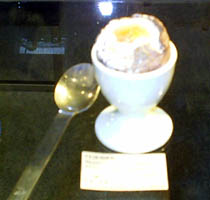
Thunderegg ??? (photo RDS)
A propos de publications
Nous renseignons ci-dessous les noms de ceux qui contribuèrent à l’étude de ces « étranges mais étonnants et surprenants minéraux, ainsi que la date d’une publication significative, ceci permettant au lecteur de poursuivre des recherches bibliographiques plus pointues, sur Internet par ex.
| 1761 - J.F. Hoffman |
1773 – Brückmann |
1776 - Collini |
| 1816 – Fournet |
1827 – Berzelius |
1832 - Leonhard |
| 1844 – Brewster |
1849 - Noeggerath Jakob |
1850 - Kenngott Gustav Adolph |
| 1864 – Reusch |
1896 - Bauer Max |
19è - Haidinger Wilhem |
| 19è - Lange |
|
|
| 20 è - Schossmacher |
1915 – Liesegang |
1930 - Bryan W. |
| 1948 - Nacken R |
1951 - Dake H.C. |
1984 - Landmesser |
| 1984_1986_1988_ Landmesser |
1987 – Blankenburg |
1989 - Rykart Rudolf |
| |
1989 – Shaub B.M. |
1997 - Schmidt J. |
| 1999 et 2001 Holzhey |
|
|
| 2002 Clark R. |
2002 – Wahl C. |
|
| 2000_2001_2004 Landmesser |
|
|
| 1996_2004 Mowon Terry |
|
|
Dans le tableau que nous avons compilé, nous pouvons voir que les découvertes toutes récentes (2004) méritent d’être suivies.Pour nos lecteurs de langues russes et slaves, ainsi que nos amis japonais, coréens et chinois et ceux de langue hispanique, nous regrettons de n’avoir pu consulter les travaux existant dans leur langue. Nous les prions de nous excuser. (le cas échéant transmettre les infos au rédacteur ).
|
|
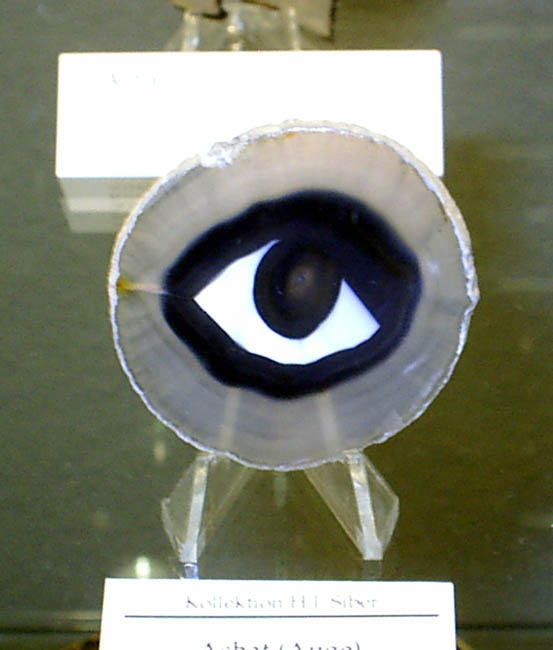
Eye Agate (photo RDS) |
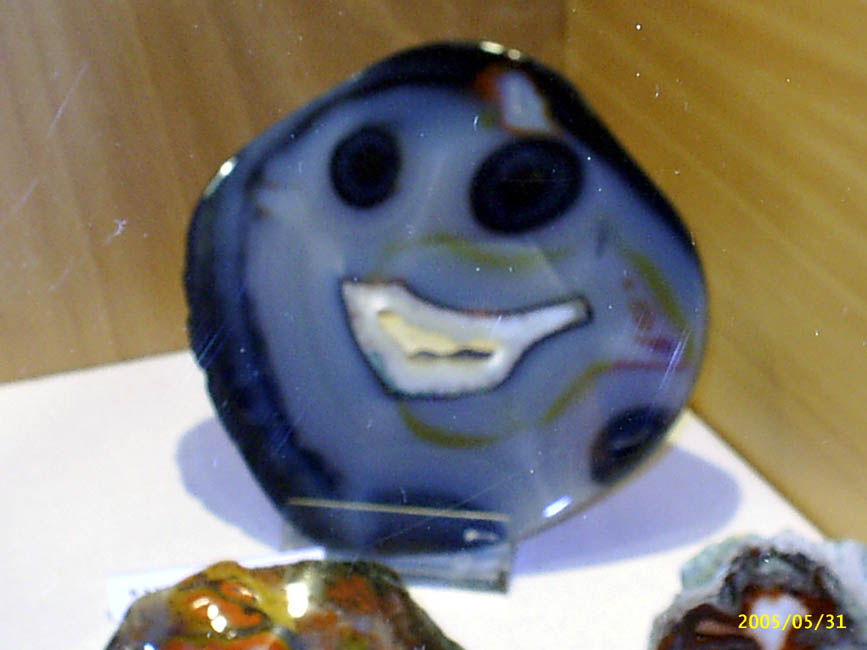
Quelle famille ? (photo RDS) |
12. Coloration artificielle des minéraux : un sujet TRES sensible
La teinture: vous la voulez plus bleue ou un peu plus rouge?
Très tôt la fine porosité des agates a été utilisée pour leur coloration. Qui dit porosité dit facteur d’absorpsion, donc, vous avez tout compris.
La mise en circulation d’agates teintées ne date pas d’hier :
- Il y a 2000 ans déjà, Pline décrivait les traitements artificiels pour fabriquer de l’onyx noir.
- A Constantinople, la coloration était utilisée pour donner naissance à de faux onyx, artificiellement rayés de blanc et de noir.
- Dake signalait en 1938 que l’aventurier portugais du 16è siècle, Duarte Barbosa rapporta que dans la ville indienne de Limodra les
agates étaient passées au feu pour accentuer les nuances de rouge.
Comment faire? (NDLR ... Nature demolition workshop? )
Il faut savoir que chez les scieurs d’agates (Idar Oberstein par ex), le procédé de teinture des agates était “secret défense”,
même durant les temps les plus difficiles. Nous avons levé pour vous cette contrainte.
Le procédé est simple :
- Atelier No 1: Prenez une agate du Brésil ou d’Uruguay, grise ou bleu-gris de préférence.
- Activez sérieusement les particules de fer par un solide traitement thermique et vous obtenez un rouge intense à un rouge/brun.
- Ces couleurs typiques seront très appréciées de vos acheteurs asiatiques.
- Atelier No 2 : Vous travaillez à l’ancienne – Comme à Constantinople : c’est Byzance ...
- Trempez durant 3 semaines les agates dans du miel ou un sirop de sucre (si, si, ...).
- Laissez agir, puis plongez les dans de l’acide sulfurique concentré.
- Résultat, la matière organique se transforme en carbone ... noir dans les parties poreuses, celles ne l’étant pas ou moins restent blanches.
- Utilisez de préférence du brésilien.
- Si vous voulez réduire de façon drastique vos temps de travail, faites bouillir vos pièces dans l’acide sulfurique. (...l’enfer n’est pas loin)
- Atelier No 3 : Bauer (1896) vous conseille ceci :
- “Nuancer les bleus du plus délicat et profond indigo vers un bleu-ciel ou azur se fait par trempage dans de la potasse de prusse jaune, après quoi, vous faites mijoter au feu dans du vitriol de fer. Vous obtenez un bleu berlinois ...”
- etc ...
- Atelier No 2678 et suivants :
- http://galleryvoltaire.com/agates.html
- Vous y avez quasi toutes les recettes et ingrédients
- Au passage, si vous vous sentez une âme de chimiste en herbe : prenez vos précautions
NDLR: Cette pratique de teinter les agates pour “booster” les effets de couleurs sont donc pratique courante et universelle : des "bleus" pétants, des "roses" horribles et autres "verts" innommables ne sont pas des exceptions, que du contraire. Les vrais négociants sérieux précisent la nature du “processus” ajouté par l’homme. On peut discuter sur la validité de telles pratiques et du crédit à donner pour ce type de négoce.
Le fait est là: les produits sont sur les étals. Je dirais que de bon sens, il faut dénoncer ceux qui trichent et mettent à l’index ceux qui sciemment “oublient” de le déclarer lors de la vente, ou jurent leurs grands dieux que les bleu étonnamment intenses sont naturels (alors que la nature les a faits gris-brun ...).
13. Galerie de Photos
A titre d’information nous renseignons quelques sites à titre d’exemples parmi beaucoup d’autres :
Toutefois, rien de tel que la consultation d’un “beau livre de collection”. Dans le livre qui nous sert de balise pour notre chemin de découverte, nous avons pu admirer à notre rythme 520 pages richement documentées de photos extraordinaires, rien que de photos d’agates classées par lieux géographiques, l’Allemagne (merci pour l’Europe) se taillant (. . .) pas moins de 100 pages dans ce beau gâteau.
| |
|
Europe |
|
|
| Allemagne
(+de 100p) |
France |
Royaume Uni |
Islande |
Italie |
| Autriche |
Pologne |
Rep Tchèque |
Turquie |
Hongrie |
| Russie |
Kazakhstan |
|
|
|
| |
|
Asie |
|
|
| Irak |
Iran |
Mongolie |
Inde |
Indonésie |
| Chine |
Japon |
|
|
|
| |
|
Amérique Latine |
|
|
| Argentine |
Brésil |
Uruguay |
Mexico |
|
| |
|
USA |
|
|
| Alabama |
Alaska |
Arizona |
Colorado |
Hawaï |
| Idaho |
Californie |
Kentucky |
Louisiane |
Minnesota |
| Missouri |
Montana |
Nevada |
New Mexico |
Oregon |
| South Dakota |
Utah |
Washington |
Wyoming |
|
| |
|
Canada |
|
|
| Nova Scotia |
Ontario |
Manitoba |
Colombie Britannique |
|
| |
|
Afrique |
|
|
| Maroc |
Algerie |
Botswana |
Malawi |
Mozambique |
| Namibie |
Afrique du Sud |
Madagascar |
|
|
| |
|
Australie |
|
|
| |
|
|
|
Nouvelle -Zélande |
14. Des projets de voyage culturel
Munich 2005 : un peu tard
Les 28 au 30 octobre 2005 a eu lieu la 42ème exposition « Mineral – Gem & fossiles » de Munich avec le thème particulier « Agate Dream ». Rassurez-vous si vous avez raté le coche, le livre de Zenz est sorti à cette époque.
Il est vrai que la « Hooded Owl », cette chouette agate était visible sur place, mais elle restera désormais à l’admirer en 2 dimensions. Pour ceux qui entendent parler pour la première fois de cette agate, il s’agit d’une agate mexicaine, propriété de Mr Brad Cross, qui représente d’une manière très étonnante une chouette effraie apache sur fond bleu-nuit.
Tsarskoye Selo
Un monument au Tsarskoye Selo , le Village des tsars à St Petersbourg.
Lors de votre séjour dans cette superbe ville d’art, n’oubliez pas de visiter le « Pavillon des Agates » du palais Ekaterininski, construit en 1780 ; les directeurs et spécialistes confirmés en gemmologie Boris Igdalow et Wladimir Mesentzev vous commenteront le résultat de leurs efforts dans la restauration et la préservation de cet incroyable musée consacré aux agates, jaspe et autre « amber room ».
Visite au musée d’Idar Oberstein
http://www.edelsteinmuseum.de/index.htm
Des vacances actives ?
- Si vous voulez passer des vacances dans la mine d’agates du Mont Lyall à Sainte-Anne-des-Monts (Qc-Canada) : «
L’activité récréotouristique se déroule dans une mine à ciel ouvert et consiste en la cueillette d’agates et géodes par les visiteurs.
Il y a une exposition de minéraux comportant 250 échantillons, de l’animation sur le site et une boutique où des minéraux sont en vente.
Aussi, sciage de pierres sur place. » Pourquoi pas ? http://www.mont-lyall.com
15. Des inventaires …
- Site à découvrir de Roger Pabian, Research Geologist, Emeritus, Conservation and Survey Division University of Nebraska-Lincoln - Lincoln, Nebraska
Plus de 3000 références …http://snr.unl.edu/...
16. L’agate – Pierre de l’Amour ?
L’agate … bon pour la psyché, bon pour le corps ?
17. Philatélistes : à vos pinces
En mémoire de Pierre Forget (1923 +30/01/2005), dessinateur et graveur de timbres-poste.
« L'agate », en janvier 2005 a été le dernier timbre émis de son vivant,
un de la série des minéraux des TAAF (Terres australes et antarctiques françaises).
http://stampmin.home.att.net/ sélectionner « agate »
http://www.minerauxetfossiles.com/...
http://www.minerauxetfossiles.com/...
http://www.taaf.fr/...
http://www.netarmenie.com/...
http://www.nautilusgent.be/ sélectionner Fotos - Filatelie – Kenia
http://www.geo.uw.edu.pl/...
http://www.geo.uw.edu.pl/...
18. Littérature
http://www.agate-nodule.com/ Sous le titre « Beautiful Agates », la page d’accueil fait la publicité de l’ouvrage « The beauty of Banded Agates » de Michael R. Carlson. Plaidoyer pour les beautés des pierres, la fascination des couleurs et de l’esthétique. Belles photos « World class ».
http://www.agate-nodule.com/... : Présentations de 5 ouvrages de factures différentes
Si vous êtes vendeur de votre collection d’agates : http://www.agatenodule.com
Ces liens vous permettront de faire un petit tour de la question en images :
19. Encore des références
http://www.mindat.org/search.php?name=Agate
LAPIS No 9 – 1988 – Bau und Bildung der Achate pp 11 à 28
Revue CMPB – Novembre 2002
20. De tout un peu
http://www.naturenw.org/rock-thundereggs.htm
http://www.mikalina.com/agates_geofacts.htm
21. Pour conclure
Cher lecteur, si vous êtes parvenu à lire et consulter tous les liens hypertextes, bravo, vous avez certainement effectué une excursion extraordinaire dans le monde méconnu des agates. Votre vision de ces minéraux est probablement autre. Peut-être une nouvelle passion est-elle née dans la recherche d’autres photos ou dans la quête de réponses aux questions qui peuvent apparaître ?
Peut-être également avez-vous eu l’audace de prendre votre clavier ou votre plume pour contacter telle ou telle université ?
Pour ma part, la rédaction de cette modeste synthèse fort incomplète et provisoire m’a invité à énormément de modestie devant un simple mot « Agate » qui laisse percoler quelques gouttes des merveilles et des secrets de la nature.
A la recherche d’un nouveau Graal ? (*) Et si tout compte fait, il était en agate …
(*) Nom fort répandu au Moyen-Age du XIe au XVe siècle. Il désigne communément une coupe, un vase.
Bon succès dans votre pérégrination avec Dame Nature.
10/01/2006 - GDQ
MAJ 29/12/2007 - MJX
Si vous connaissez d’autres références, envoyez-les au rédacteur qui se chargera avec grand plaisir de compléter la documentation de base du CMPB :
References – divers
Livres parus après 2004
CD – DVD
Formation des agates
Galeries de photos
Musées – expositions – causeries, etc...
|